A Monad wallet is an Ethereum-style wallet that holds MON, Monad's native coin, and tokens built on Monad. You use the same 0x address you have on Ethereum, and every transaction pays its fee in MON. Blocks arrive about every 300 milliseconds and become final in roughly 600.
Monad copies Ethereum's surface but changes what happens underneath, and two of those changes reach your wallet. Monad charges for the gas limit a transaction sets, not the gas it uses. It also guards a reserve of 10 MON in each account, which is why a send near the bottom of a balance can revert. Figures below are as of October 2026.
Monad at a glance#
Item | Monad |
|---|---|
Native coin | MON (18 decimals) |
Address format |
|
Chain ID | 143 |
Blocks and finality | About 300 ms blocks, full finality after about 600 ms |
Gas billing | The full gas limit, with a minimum base fee of 100 gwei |
Typical fee | About 0.002 MON for a MON transfer, a tiny fraction of a cent |
Reserve balance | 10 MON per account, with one exception for emptying a wallet |
Token standard | ERC-20 |
Explorers | Monadscan and MonadVision |
In Keylo | Send, receive, ERC-20 tokens, speed-up, swap and bridge through LI.FI, the Monad Testnet and Activity for sends made in Keylo, but no staking, dapp connections or NFT view |
How a Monad wallet works#
Monad is a layer 1 that runs the Ethereum Virtual Machine. Its validators agree on the order of transactions first and execute them a moment later, in parallel where they don't touch the same state. That split is where both of Monad's wallet rules come from.
Your Monad wallet address#
Your Monad wallet address is a plain 0x address, identical to the one you use on Ethereum or Base, because the same key creates it. Keylo derives it on m/44'/60'/0'/0/0, the path MetaMask uses for its first account, and shows it for every EVM network you hold.
The balance belongs to Monad alone. MON sent on Monad appears there, and nowhere else. No activation, memo or minimum deposit is needed before the address can receive.
Where Monad differs from Ethereum#
You pay for the gas limit. The Monad gas docs are blunt: the gas charged is the gas limit. Unused gas isn't refunded, because blocks are agreed before anyone knows what execution will cost.
There's no global mempool. Nodes forward your transaction to the next few block leaders instead of a public waiting room.
A reserve protects pending fees. Consensus has to be sure every queued transaction can still pay for gas, so it watches a 10 MON buffer.
A simple MON transfer always uses 21,000 gas, so the first rule changes nothing there. It matters for token transfers and swaps, where a generous limit costs real MON. Keylo sets the limit from a simulation of the transfer, adds a small safety margin for token transfers, and shows the fee for that whole limit, which on Monad is what you pay.
The 10 MON reserve balance explained#
Monad's reserve balance rule sets aside 10 MON per account. A transaction that sends MON and would leave you below that amount normally reverts.
There's one exception, made for emptying a wallet. You can go below 10 MON, even to zero, if both of these are true:
Your account hasn't sent any other transaction in the last three blocks, roughly a second.
Your account isn't delegated to a smart contract through EIP-7702, and hasn't changed its delegation in those three blocks.
So a single send can drain a fresh account. The trouble starts with a quick second one. If you fire off another transaction before three blocks pass, it can be dropped, or included and reverted. A reverted transaction still pays its gas.
Accounts delegated with EIP-7702 never get the exception. If you once upgraded this address to a smart account in another wallet, any send that would take it below 10 MON reverts. Removing the delegation brings the exception back.
How to choose a Monad wallet#
Any EVM wallet can hold MON once Monad is added as a network, so match the wallet to how you'll use the chain.
Extension wallets. MetaMask and Rabby live in your browser and connect to Monad's DEXs, lending markets and staking apps once you add the network.
Hardware wallets. A device such as a Ledger keeps the key offline and signs through an extension wallet. It's the right home for a balance you won't touch for months.
Exchange accounts. Easy for buying MON, but the exchange holds the keys.
Web wallets. Keylo runs in a browser tab and needs no installation.
On Monad, a good wallet already knows chain ID 143 and estimates gas carefully, because padding costs you. It should simulate transfers, warn about contract recipients and show token contract addresses.
Keylo suits holding and sending MON and stablecoins, plus swapping or bridging with the phrase you already use on other chains. It's a poor match if you want to stake MON or trade on Monad apps, because Keylo can't connect to them.
Adding Monad to MetaMask or Trust Wallet#
Monad's docs list MetaMask, Rabby, Trust Wallet, OKX Wallet, Backpack and Zerion among the wallets that support it, so first look for Monad in your wallet's network selector. If it isn't there, add a custom network with the values from Monad's network page: chain ID 143, RPC URL https://rpc.monad.xyz, currency symbol MON and explorer https://monadscan.com. Your Monad wallet address is then the same 0x address that wallet already shows on Ethereum.
How to create a Monad wallet in Keylo#
Monad comes built into Keylo's network list, so there's nothing to configure.
Visit the sign-up page and type your full name, email and phone number. Choose a password, repeat it, accept the terms, then tap Create account.
Confirm your address from the email if Keylo shows "Check your inbox".
Pick Create a new wallet. Your browser creates the 12-word phrase and seals it with a key from your password (Argon2id, then AES-256-GCM). Only that sealed copy goes to Keylo's server.
Find Monad in the asset list. It shows your MON balance and
0xaddress.Copy the phrase onto paper from Settings, Recovery phrase after typing your password. Then confirm the words Keylo asks for.
Add Two-factor authentication and an Anti-phishing code before you deposit.
That paper backup is your only way back in. Keylo can't read your wallet, so resetting a forgotten password won't decrypt it.
Bringing your MetaMask wallet#
Choose Import a recovery phrase and type the 12 or 24 words. Because Keylo uses the standard EVM path, your first MetaMask account shows up with the same Monad balance. Other accounts from that app won't appear in Keylo, but they keep their MON.
Try it on the Monad Testnet#
Under Settings, Networks, turn on Testnet mode and the Monad Testnet joins your list. Open it and Keylo links to the Monad faucet for free test MON. Test MON has no value, so it's a safe way to try the reserve rule and fee levels.
Get a Monad address in a minute
Sign up with an email and password. Your browser creates the wallet, with one 0x address for Monad and every other EVM network Keylo supports.
How to receive MON#
Tap Receive and choose Monad. The screen shows "Receive on Monad" and a QR code.
Use Copy or Share, or let the sender scan the code.
On an exchange, set the withdrawal network to Monad. MON or wrapped MON on another network won't arrive here.
Watch your MON balance. With sub-second finality, a deposit lands about as fast as the sender releases it. Keylo's Activity on Monad records only transfers sent from Keylo, so check Monadscan to see the incoming transaction itself.
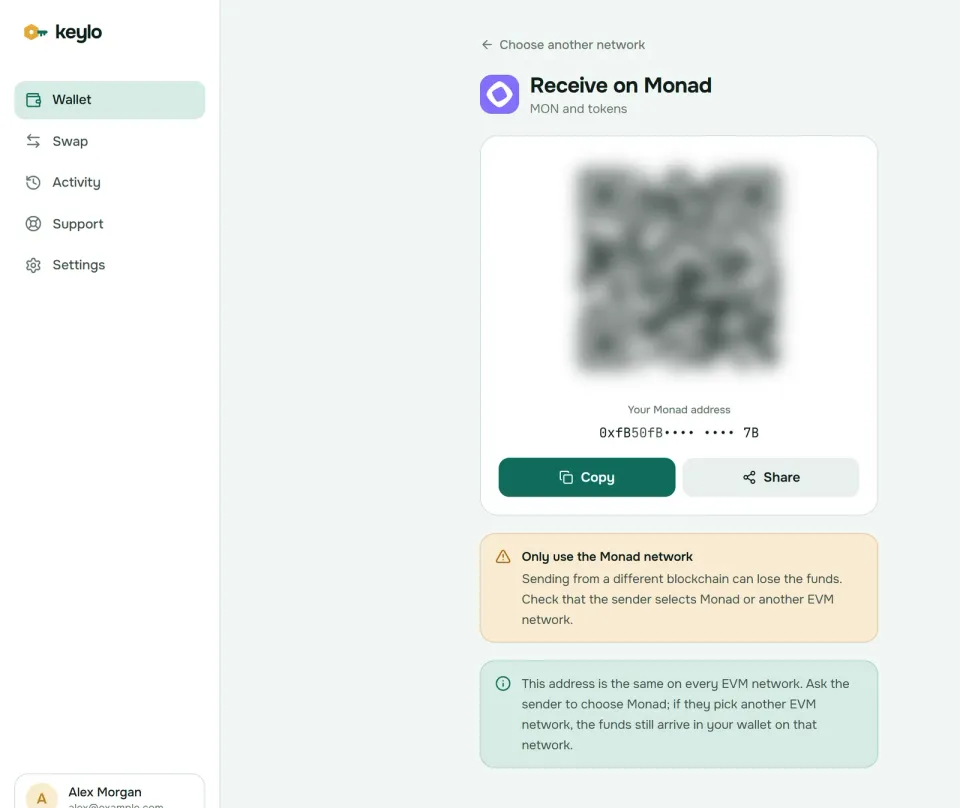
Keylo's Receive screen notes that your address is shared across EVM networks. A sender who picks Ethereum or Arbitrum by mistake still pays you, just on that network. You'll find the funds under it in Keylo and can bridge them to Monad.
How to send MON and Monad tokens#
Tap Send and select MON or a Monad token.
Enter the recipient in To, by paste or QR scan. Keylo validates the format and checksum.
Type the amount, or use Max to send everything except the fee.
Tap Review and pick Fast, Normal or Slow from the listed costs.
Look over the network, recipient and fee in MON.
Tap Send. Keylo signs in your browser and shows "On its way", then "Sent", linking to Monadscan.
Before you sign, Keylo simulates the transfer and stops one that would fail. It warns when the recipient is a smart contract, since tokens sent to a contract that doesn't expect them are usually lost. It also blocks a token sent to its own contract address. If you hold USDC but no MON, it tells you to get MON for the fee first.
Max on Monad leans on the emptying exception, so use it as your only send of the moment. If a transfer stays pending, Speed up resends it with a higher fee, but on Monad that's rarely needed.
Monad gas fees explained#
Monad's fee works like Ethereum's EIP-1559, with a base fee and a priority tip, both in MON. The base fee never drops below 100 gwei, and it rises slowly under load but falls fast. On October 24, 2026, the network quoted about 102 gwei: the 100 gwei floor plus a 2 gwei tip.
The cost is the gas limit times the price. A MON transfer at 21,000 gas comes to about 0.002 MON, and MON traded near $0.02 that day, so the fee was about $0.00005. Monad's own docs put a typical 200,000-gas contract call at about 0.02 MON.
Tips matter less here than on Ethereum. With the suggested tip that small, Keylo's Slow, Normal and Fast levels cost almost the same. Higher settings mostly raise the fee cap you allow, which helps only if demand spikes while you wait. Keylo adds no fee to a normal send.
Swap and bridge MON#
Monad tokens follow ERC-20 and need MON for gas. Bridges bring stablecoins and wrapped coins in from other chains, and each bridge can mint its own version of the same coin. Circle issues USDC on Monad directly, at 0x754704Bc059F8C67012fEd69BC8A327a5aafb603. Compare that contract before sending USDC to an exchange.
Keylo looks for well-known tokens such as USDC automatically. Add anything else by contract under Settings, Networks, Custom tokens.
For swaps and bridges, Keylo uses LI.FI, which compares Monad DEXs and cross-chain bridges:
Tap Swap and choose what you pay: MON, a Monad token, or a coin on another chain.
Under You receive, pick the network and token. Search, or paste a contract.
Compare routes by amount, time and fees.
Check Minimum you receive and Delivered to, your own address on the destination chain.
Confirm and follow the tracker until the funds land.
Swapping nearly all your MON triggers the same reserve rules as a send, so leave a cushion unless you mean to empty the account. Default slippage is 0.5%. A bridge delivers or refunds, sometimes in a different token that still lands in your wallet. Any Keylo service fee has its own line. The swap and bridge overview explains more.
Monad scams and mistakes to avoid#
Copycat tokens. New tokens on Monad often borrow famous names. Check every contract on Monadscan against the project's own site, and ignore tokens that arrive unasked.
Wallet checkers and points sites. A genuine "Monad wallet checker" or score page needs only your public address. One that asks you to connect, sign or type a phrase is the usual drainer route. Keylo can't sign website requests, so it can't be used that way.
Back-to-back sends. Rapid transfers from a nearly empty account waste gas on reverts. Space them out.
Address poisoning. Scammers send dust from lookalike addresses. Take addresses from the source, never from history.
Fake support. Keylo staff never ask for your phrase or password. Contact the team through Keylo support, and read Keylo's security overview.
Keylo also has limits on Monad. Staking means delegating MON to a validator, and unstaked coins wait one epoch, roughly four hours, before you can withdraw them. Keylo stakes only on Cosmos SDK chains, so use a staking app with an extension wallet for that. Without a browser extension or WalletConnect, Monad dapps are out of reach. Keylo shows no NFTs, doesn't pair with hardware wallets and doesn't sell MON by card. If you lose both your password and your phrase, the wallet can't be recovered by anyone. The supported networks list shows where else the phrase works.
A quick check before your first real transfer:
Your phrase is on paper and confirmed.
You hold MON on Monad for gas.
The exchange's network says Monad, not Ethereum or a testnet.
If your balance is low, you're sending one transfer at a time.
A small test arrived first.
Other fast EVM chains work with the same phrase. See the Sei wallet guide, the MegaETH wallet guide and the Ethereum wallet guide.
Hold MON in a wallet only you control
Keylo encrypts your recovery phrase on your device and never sees it. Send, swap and bridge MON in one place.
Monad wallet FAQ#
Why can't I send all my MON?
Monad keeps a 10 MON reserve in each account so queued transactions can always pay gas. You can drop below it, even to zero, with one transaction if your account sent nothing in the previous three blocks and isn't delegated through EIP-7702. If you just sent something, wait a second and try again. Delegated accounts must always keep 10 MON.
Why did my Monad transaction revert but still charge gas?
Usually because of the reserve rule. If a transaction would leave less than 10 MON and doesn't qualify for the emptying exception, Monad can include it and revert it, and a reverted transaction still pays for its gas. The common cause is a second send fired off right after the first. Wait for each transfer to show Sent before starting another.
Does Monad refund unused gas?
No. Monad charges the full gas limit a transaction declares, because blocks are agreed before they're executed. A plain MON transfer always needs 21,000 gas, so it's unaffected. Token transfers and swaps cost whatever limit the wallet sets, so careful estimates matter. Keylo bases the limit on a simulation, with a small margin for token transfers, and shows the full fee before you sign.
Is my Monad address the same as my Ethereum address?
Yes. Monad uses Ethereum's address format, so one key gives you the same 0x address on Monad, Ethereum and every other EVM chain. Balances stay separate, though. MON sent on Monad is only on Monad, and funds sent on another chain stay there until you bridge them. In Keylo, open Monad in your asset list to see its balance.
How much does it cost to send MON?
Very little. Monad's base fee has a floor of 100 gwei, and on October 24, 2026, the network quoted about 102 gwei including the tip. A MON transfer uses 21,000 gas, so the fee is about 0.002 MON, roughly $0.00005 at that day's price. Token transfers and swaps use more gas. Keylo lists the cost of Slow, Normal and Fast before you confirm.
How fast are Monad transactions?
Monad produces blocks about every 300 milliseconds and reaches full finality after two of them, around 600 milliseconds. In Keylo the status usually turns to Sent within a few seconds, because Keylo checks the network every few seconds after you broadcast. Exchanges may still wait a little longer before crediting a deposit, so allow a few minutes there.
Can I stake MON?
Yes, by delegating to a validator through a staking app, but not in Keylo, which offers staking only on Cosmos SDK chains. Unstaked MON waits one epoch, roughly four hours, before you can withdraw it. Use an extension wallet such as MetaMask or Rabby with the same phrase for that. Keylo still holds, sends, swaps and bridges MON and Monad tokens.
How do I get test MON for the Monad Testnet?
Turn on Testnet mode in Keylo's Settings, under Networks, and the Monad Testnet appears with your usual 0x address. Open it and follow the link to the Monad faucet to claim free test MON. Test coins have no value and can't be swapped or bridged into real MON, so anyone selling them is running a scam.