A Tron wallet holds the key to a Tron address, the T... address where TRX and TRC20 tokens like USDT sit. Most people arrive here because someone asked them for "USDT TRC20". That simply means Tether's dollar token on the Tron network, and it's one of the most common ways to move USDT between exchanges and people.
Tron is quick and fairly cheap, but its fee system works differently from other chains. You never pay fees in USDT. Every transfer spends two resources, energy and bandwidth, and if you have none, the network burns TRX to cover them. So a Tron wallet that holds only USDT can't send it. Keep that in mind and the rest gets easy. Figures below are as of October 2026.
Tron at a glance#
Item | Tron |
|---|---|
Native coin | TRX (1 TRX = 1,000,000 sun) |
Address format | 34 characters starting with |
Fees | Bandwidth for every transaction, energy for token transfers, paid by burning TRX when you have none staked |
Typical USDT fee | About 6.4 TRX without staked energy, or about 13 TRX when the recipient holds no USDT |
Free allowance | 600 bandwidth points a day for each activated address, no free energy |
Speed | A block every 3 seconds, irreversible after about a minute |
Token standard | TRC20 (USDT contract |
Explorer | |
In Keylo | Send and receive TRX and TRC20 tokens, notes, history, TRX swaps through THORChain, Tron Nile testnet. No staking, energy rental or dapp connections |
How a Tron wallet works#
Your TRX and tokens live on the Tron ledger, not inside the app. The wallet keeps the private key that signs transfers, and anyone who has that key, or the recovery phrase behind it, controls the address.
Your Tron wallet address#
A Tron address starts with a capital T and runs 34 characters. It carries a checksum, so a single typo makes it invalid instead of sending money somewhere random. Developer tools sometimes show the same address in hex, starting with 41.
There's only one address per account. Your TRX address, your TRC20 address and your USDT address are all the same T... string. Keylo derives it from your recovery phrase on m/44'/195'/0'/0/0, the standard Tron path for a wallet's first account.
How to activate a Tron wallet#
A fresh Tron address doesn't exist on chain yet. It becomes an account the first time someone sends it TRX (or a TRC-10 token). The sender pays a one-time creation fee, 1 TRX on mainnet plus 0.1 TRX of bandwidth in most cases, according to the Tron account documentation.
USDT doesn't count. A TRC20 transfer changes a balance inside the USDT contract, so it doesn't activate the address. Your USDT still arrives at the address, but the address can't send anything until some TRX lands there too. Until then it also gets no free daily bandwidth.
Energy and bandwidth: what USDT TRC20 transfers cost#
Tron prices every transaction in resources, not in a gas price you bid.
Bandwidth pays for the size of the transaction in bytes. Every activated address gets 600 free points a day, refilling gradually. If your free or staked bandwidth can't cover the whole transaction, Tron burns 1,000 sun (0.001 TRX) per byte instead.
Energy pays for running a smart contract, which is what a USDT transfer is. Nobody gets free energy. Without staked energy, Tron burns 100 sun per unit. That price dropped from 210 sun on August 29, 2025, after a governance vote, and it's still 100 sun in October 2026.
Here's what that means in practice, with TRX at about $0.33 on October 24, 2026:
Transfer | What it uses | TRX burned if you have no staked resources |
|---|---|---|
TRX to an activated address | About 270 bandwidth | Nothing while free bandwidth lasts, otherwise about 0.27 TRX |
TRX to a brand-new address | Account creation | About 1.1 TRX on top of the amount |
USDT to an address that holds USDT | About 64,000 energy and 345 bandwidth | About 6.4 TRX, roughly $2.10 |
USDT to an address with no USDT | About 130,000 energy and 345 bandwidth | About 13 TRX, roughly $4.30 |
Any transfer with a note | A memo fee | 1 TRX extra |
The free 600 points cover roughly one USDT transfer or two TRX transfers a day. After that, bandwidth costs a few tenths of a TRX per transfer.
Why some USDT transfers cost double#
The USDT contract has to write a new balance entry when the recipient has none. That extra storage roughly doubles the energy. A wallet that already holds some USDT sits in the cheaper row, while a brand-new wallet sits in the expensive one. Keylo's fee estimate already reflects which case applies.
Ways to pay less#
Stake TRX for energy. Staking (Tron calls it Stake 2.0) gives your address a daily energy allowance. Unstaked TRX takes 14 days to come back, per the live network parameters. Keylo can't stake, but it reads any energy and bandwidth your address already has and burns TRX only for the shortfall.
Rent energy. Third-party services delegate energy to your address for a fee. Keylo uses delegated energy the same way, but research a provider before paying, since you're sending TRX to a stranger.
Gas-free modes. Some wallets let a sponsor pay the TRX and charge you in USDT instead. Keylo doesn't offer this.
The resource model documentation covers the exact charging order.
How to choose the best Tron wallet for USDT#
Four kinds of wallets hold USDT on Tron, and the right one depends on what you'll do with it.
TronLink is the long-standing Tron wallet, as a browser extension and a mobile app. Its site lists TRX staking for resources and voting, a dapp browser, multisignature accounts and Ledger import.
Multi-chain mobile apps such as Trust Wallet hold Tron next to many other networks.
Hardware wallets keep the key on a separate device, which suits savings you rarely touch.
Exchanges hold the key for you. That works for trading, but the exchange decides when you can withdraw.
Whichever you pick, check how it handles Tron's fees. A good USDT TRC20 wallet shows the energy and TRX cost before you sign, warns you when your TRX won't cover it, and identifies USDT by its contract address rather than its name.
Keylo suits people who hold and move USDT and TRX and want everything in a browser tab with nothing to install. It isn't the tool for staking TRX, voting for Super Representatives or using Tron dapps, because it does none of those. If you send USDT many times a day, a wallet that can stake for energy can save you money.
How to create a Tron wallet in Keylo#
Keylo runs in a browser on your phone or computer. You can pin it to the home screen so it opens like an app.
Go to Keylo's sign-up page. Fill in Full name, Email, Phone number, Password and Confirm password, tick the terms box and press Create account.
If you see "Check your inbox", open the confirmation email first.
On "Set up your wallet", choose Create a new wallet. Keylo generates a 12-word recovery phrase in your browser, then encrypts it with a key made from your password (Argon2id, then AES-256-GCM). The server only ever receives the locked copy.
Tap Tron in the asset list. Your
T...address, TRX balance and history appear there, and USDT shows up once you hold some.Open Settings, then Recovery phrase. Type your password, copy the 12 words onto paper and confirm the ones Keylo asks for.
While you're in Settings, add Two-factor authentication and an Anti-phishing code.
Write the phrase down before you fund the wallet. A password reset can't decrypt the wallet on its own, so the phrase is your only way back in.
Bringing a TronLink or Trust Wallet phrase#
Pick Import a recovery phrase on the setup screen and type your 12 or 24 words. Because Keylo uses the standard Tron path, the first account from another wallet normally appears with the same T address and balances. Extra accounts you added in TronLink use other paths, so they won't show in Keylo, though their funds stay where they are.
Try it on Tron Nile first#
Under Settings, Networks, switch on Testnet mode. Keylo adds Tron Nile, a test network with free TRX from the Nile faucet and a test version of USDT. It's a cheap way to watch activation and energy charges happen before real money moves.
Get your Tron address in a minute
Sign up with an email and a password. Keylo builds the wallet in your browser and gives you a T address for USDT and TRX.
How to receive USDT TRC20 and TRX#
Press Receive and pick Tron. You'll see "Receive on Tron", a QR code and "Your Tron address".
Copy the address with Copy, send it with Share, or let the other person scan the code.
On an exchange, choose TRC20 or Tron (TRX) as the withdrawal network. USDT on Ethereum (ERC20) or BNB Smart Chain (BEP20) won't arrive at a
Taddress.Watch your Tron activity. Transfers usually show within seconds, each with a Tronscan link.
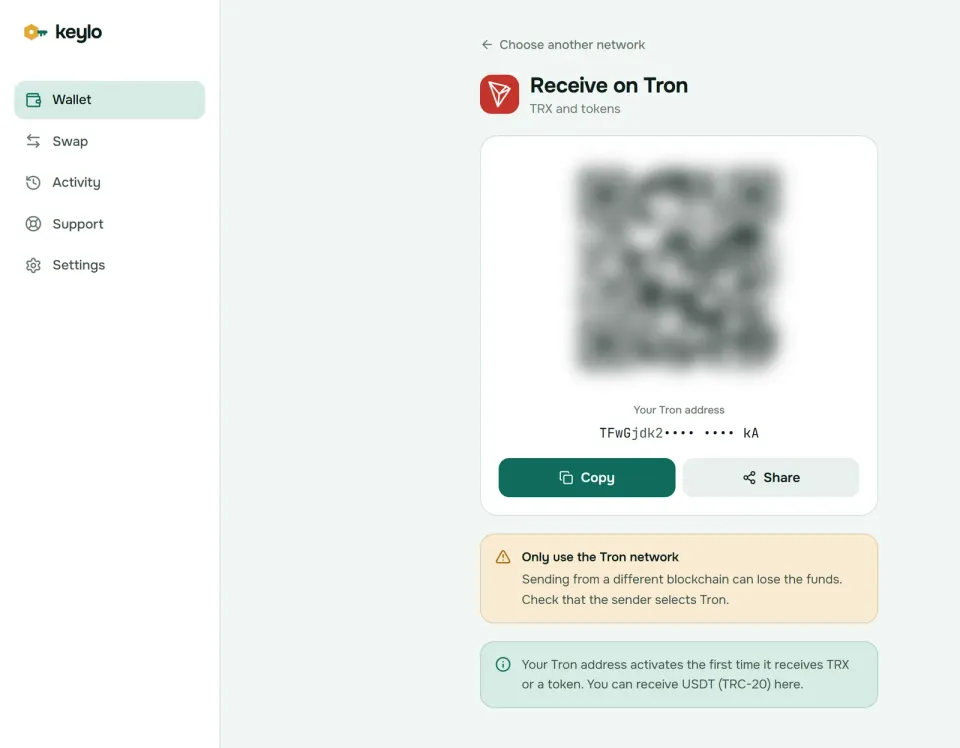
The same address takes TRX, USDT and every other TRC20 token, and you never need a note to receive into your own wallet. Before a large withdrawal, send a small amount, check that it arrived, then move the rest.
How to send USDT on Tron#
Press Send and pick USDT on Tron (or TRX).
Fill in To by pasting or scanning. Keylo checks it's a valid
Taddress with a correct checksum.Enter an amount, or press Max. For TRX, Max subtracts the fee and sends the rest.
Leave Note empty unless the recipient asked for one. Tron charges 1 TRX for every note.
Press Review. Tron has no fee bidding, so there are no Slow, Normal or Fast options, just one fee in TRX and its dollar value.
Compare the recipient on the review screen, especially the bold first and last characters, then press Send. Keylo signs in your browser and shows "On its way", then "Sent", with a View on Tronscan link.
What Keylo checks before you sign#
Keylo test-runs every USDT transfer against the contract before you sign. It then works out the energy from that run and the bandwidth from the transaction's real size. It also counts any staked or delegated resources you have, so the fee on the review screen is a close estimate of the TRX Tron will burn.
No energy. The review shows how much TRX will go to energy, with a note that staked TRX would make it cheaper.
Not enough TRX. The send stops with the TRX amount you need, instead of failing on chain.
A new recipient. Sending TRX to an address that doesn't exist yet shows the 1.1 TRX activation fee, already added in.
An unactivated sender. If your own address has never received TRX, Keylo asks you to receive some first.
The token's own contract. Keylo blocks USDT sent to the USDT contract address, a common paste mistake.
Keylo also caps the energy a transfer may use at about 30% above its estimate. A transfer can fail if your TRX only just covers the fee and costs rise, and Keylo warns you when that's possible. There's no Speed up on Tron, because transfers either land in seconds or expire.
Swap TRX to Bitcoin, Ether or XRP with THORChain#
Keylo gets Tron swap quotes from THORChain, a cross-chain exchange that swaps native coins without wrapped tokens. You can turn TRX into BTC, ETH, XRP and other coins THORChain supports, or bring those back into TRX.
Press Swap. Under You pay, choose TRX on Tron.
Under You receive, pick the network and coin you want.
Read the quote: the route, every fee, the estimated time and Minimum you receive.
Delivered to shows your own Keylo address on the other network, so there's nothing to paste.
Confirm and follow the progress screen until the coins land.
THORChain needs a minimum amount to cover its own costs, and Keylo tells you when you're under it. If a swap can't complete, THORChain refunds the TRX to your address minus network fees. Keylo lists any service fee of its own as a separate line. The swap and bridge page explains routes and refunds in more detail.
Keylo's swaps on Tron only cover TRX itself. To turn USDT TRC20 into something else, send it to an exchange, or withdraw TRX instead.
What Keylo doesn't do on Tron#
No staking, voting or energy rental. Keylo can't freeze TRX or vote for Super Representatives. Use TronLink for that; Keylo will still use the resources you earn there.
No dapps. There's no extension and no WalletConnect, so Keylo can't open Tron DeFi or games, and it never signs permission changes for websites.
No USDT swaps. THORChain routes in Keylo cover TRX only.
No gas-free USDT. Every transfer needs TRX or energy on your address.
No hardware wallets and no card purchases. Buy TRX or USDT on an exchange and withdraw on TRC20.
Keylo never holds your keys. That cuts both ways: if you lose the password and the recovery phrase, nobody can rebuild the wallet. The networks page shows what Keylo supports elsewhere.
Tron scams and mistakes to avoid#
More than $90 billion of USDT sat on Tron in October 2026, which makes Tron wallets the main target for stablecoin scams.
The shared-phrase trap. A stranger "accidentally" posts a recovery phrase for a wallet holding thousands in USDT. You import it and find you need TRX to move the USDT. The wallet has been switched to multisig, so your TRX goes in and nothing comes out. Never send coins into a wallet whose phrase someone gave you.
Address poisoning. Scammers send zero or tiny USDT transfers from addresses that match the start and end of one you use, hoping you copy it from your history. Copy addresses from the original source, never from past activity.
Fake USDT. Anyone can launch a token named USDT. The real one is
TR7NHqjeKQxGTCi8q8ZY4pL8otSzgjLj6t, as listed on Tether's site, and Keylo recognizes it by that contract.Wrong network. USDT sent on Ethereum or BNB Smart Chain to a
Taddress doesn't arrive. Pick TRC20 every time.Fake support and energy sites. Keylo staff never ask for a phrase or password; reach them on the Keylo support page and read how Keylo protects your account.
A quick check before your first real USDT transfer:
Your phrase is on paper and confirmed in Keylo.
Your address has received TRX and holds enough for the fee.
The withdrawal network says TRC20 or Tron.
You pasted the address and checked its first and last characters.
A small test transfer arrived first.
USDT also runs on other networks Keylo supports. The Ethereum wallet guide, the BNB Smart Chain wallet guide and the Solana wallet guide explain their fees.
Keep USDT and TRX in a wallet only you control
Keylo encrypts your recovery phrase in your browser, shows the exact TRX each transfer burns, and swaps TRX across chains.
Tron wallet FAQ#
What is the best wallet for USDT TRC20?
It depends on how you use it. If you stake TRX for energy, vote or use Tron dapps, TronLink is built for that. For holding and sending USDT and TRX from a browser with nothing to install, Keylo works and shows each transfer's exact TRX cost. Large savings belong on a hardware wallet. Any choice needs a few TRX for fees.
Do I need TRX to send USDT on Tron?
Yes, unless your address has staked or rented energy. A USDT transfer uses about 64,000 energy, and without staked energy Tron burns TRX to pay for it, about 6.4 TRX as of October 2026. Your address must also have received TRX at least once to be activated. Keep 15 to 20 TRX next to your USDT.
How much does it cost to send USDT TRC20?
As of October 2026, about 6.4 TRX when the recipient already holds USDT and about 13 TRX when they hold none, if you have no staked energy. With TRX near $0.33, that's roughly $2.10 or $4.30. Staked or delegated energy brings the burn down. Keylo shows the real figure on the review screen before you send.
How do I activate my Tron wallet?
Get some TRX sent to it. A Tron address becomes an account only after it receives TRX or a TRC-10 token, and receiving USDT doesn't count, because TRC20 balances live inside the token contract. Ask someone to send you a few TRX, or withdraw TRX from an exchange. The sender pays the one-time activation cost, and your address can send from then on.
Is my TRC20 address the same as my TRX address?
Yes. Tron gives each account one address starting with T, and it receives TRX, USDT and every other TRC20 token. There is no separate USDT address. What changes is the network you pick when withdrawing: choose TRC20 or Tron, because USDT sent on Ethereum or BNB Smart Chain can't reach a T address.
Can I import my TronLink recovery phrase into Keylo?
Yes. Choose Import a recovery phrase and enter the 12 or 24 words. Keylo uses the standard Tron path, so your first TronLink account normally appears with the same address and balances. Extra accounts created in TronLink use other paths and won't show in Keylo, but their funds stay safe and reachable in TronLink.
How long does a Tron transaction take?
Tron produces a block every three seconds, so Keylo usually shows a transfer as sent within a few seconds. It becomes irreversible after about a minute, once 19 of the 27 Super Representatives have built on it. Exchanges may wait for more confirmations before crediting a deposit, so allow a few extra minutes.
What is the Tron multisig scam?
Someone shares the recovery phrase of a wallet that shows a large USDT balance. When you import it, the USDT needs TRX for fees, so you send some. The scammer has already changed the wallet's permissions to multisig, so only they can move anything. Your TRX is gone. Never fund a wallet whose phrase a stranger gave you.