A Rootstock wallet holds RBTC, the coin of Rootstock, a smart contract chain secured by Bitcoin miners. One RBTC is backed by one BTC locked through Rootstock's two-way peg, so it moves like bitcoin in value but lives on a separate network with Ethereum-style 0x addresses. Gas on Rootstock is paid in RBTC.
Three things catch new users. Getting BTC onto Rootstock the native way takes about 17 hours. Rootstock writes addresses with a different checksum from Ethereum, so the same address can look slightly different from one wallet to the next. And Rootstock-native wallets often derive keys on a different path from MetaMask. This guide covers all three. Figures are as of October 2026.
Rootstock at a glance#
Item | Rootstock |
|---|---|
What it is | Bitcoin sidechain with an EVM, merge-mined by Bitcoin miners (formerly RSK) |
Native coin | RBTC, pegged 1:1 to BTC, 18 decimals |
Address format |
|
Native derivation path |
|
Blocks | About 30 seconds |
Fee model | Single gas price in RBTC with a miner-set minimum, no EIP-1559 |
Getting RBTC from BTC | PowPeg (about 17 hours), Flyover (about 20 minutes), or a swap |
Explorer | |
In Keylo | Send, receive, tokens, history, speed-up, read-only NFT view, swap and bridge through LI.FI. No PowPeg, Flyover or dapp connections |
How a Rootstock wallet works#
Rootstock runs the Ethereum account model next to Bitcoin. Miners can secure both chains with the same hashing work, which is called merge-mining, and smart contracts written for Ethereum run on Rootstock with little or no change. A wallet stores your key, and the chain stores your RBTC and tokens.
RBTC and the PowPeg#
The PowPeg is the bridge between Bitcoin and Rootstock. You send BTC to a Bitcoin multisig address, and the same amount of RBTC appears on Rootstock. Going back, you send RBTC to the bridge and receive BTC.
The multisig keys sit in tamper-resistant devices called PowHSMs, because no single person should hold them. Each one runs a Rootstock node and signs only transactions backed by enough cumulative proof of work. That's the trust model you accept when you hold RBTC: it isn't BTC itself, but a claim on BTC held by this peg.
Your Rootstock wallet address#
A Rootstock address has the same shape as an Ethereum one. Keylo shows the same 0x address on Rootstock as on your other EVM networks, but the balances are separate. RBTC at your address on Rootstock doesn't appear on Ethereum, and ETH at that address doesn't appear on Rootstock.
Your Bitcoin address is a different thing entirely. In Keylo the same phrase also gives you a native SegWit address starting with bc1q on the Bitcoin network. BTC lives there; RBTC lives at your 0x address. Neither network can send to the other's addresses.
Rootstock address checksums: why the capitals differ#
Most "invalid address" errors on Rootstock come from one of the next two quirks.
Ethereum addresses use capital letters as a checksum, a built-in typo check called EIP-55. Rootstock uses EIP-1191 instead, which mixes the chain ID into the checksum. The same account is therefore capitalized one way for Ethereum and another way for Rootstock. Here is the RIF token contract written both ways:
Ethereum style:
0x2AcC95758f8b5F583470ba265EB685a8F45fC9D5Rootstock style:
0x2aCc95758f8b5F583470bA265Eb685a8f45fC9D5
The bytes are identical, so they're the same account. But a strict wallet that only knows EIP-55 may reject the Rootstock version as invalid, and a Rootstock wallet may reject the Ethereum version.
Keylo accepts both versions when you send on Rootstock, as well as the all-lowercase form. If another app refuses an address only because of its capitals, convert it to lowercase. Lowercase carries no checksum, so it never changes the account, but compare every character because you lose the typo check.
The Rootstock derivation path and imported phrases#
Rootstock's registered coin type is 137, so Rootstock's address documentation gives m/44'/137'/0'/0/N as the native path. Wallets that follow it produce a different address from the same phrase than wallets using Ethereum's path, coin type 60.
Keylo uses m/44'/60'/0'/0/0 for every EVM network, like MetaMask. A phrase from a wallet that used coin type 137 will therefore open a new, empty address in Keylo. The funds are fine. They stay at the old address, and you move them by sending from the old wallet to your Keylo address.
How to choose a Rootstock wallet#
Rootstock wallets come in a few kinds:
Browser extension and mobile wallets. MetaMask works once you add Rootstock (chain ID 30). It connects to Rootstock DeFi but displays Ethereum-style checksums.
Rootstock-native wallets. These follow Rootstock's own conventions: coin type 137 and Rootstock checksums. Rootstock keeps a wallet table that marks which wallets do.
Hardware wallets. Rootstock's PowPeg guide covers peg-ins with Ledger and Trezor. Good for large BTC-backed balances.
Web wallets run in a browser tab with nothing to install. Keylo is one: it isn't an extension, but you can add it to your phone's home screen.
Before choosing, ask what you plan to do first. To peg in from BTC, pick a wallet that works with the PowPeg app. To hold and send RBTC and stablecoins alongside your bitcoin and other networks, a multi-chain wallet is simpler. Check that any wallet accepts both checksum styles, so you're not stuck when a friend's wallet writes the address differently.
Keylo fits holders who want RBTC, Rootstock tokens and their Bitcoin address under one recovery phrase. Pegging and Rootstock DeFi apps need another wallet, because Keylo can't connect to dapps.
How to create a Rootstock wallet in Keylo#
Rootstock is already on Keylo's network list, so there's nothing to configure.
Start at the Keylo registration page. Fill in Full name, Email, Phone number, Password and Confirm password, accept the terms and select Create account.
Confirm your email from the message Keylo sends if you land on "Check your inbox".
When "Set up your wallet" appears, select Create a new wallet. Your browser creates a 12-word phrase and locks it with a key derived from your password (Argon2id, then AES-256-GCM). Keylo's servers only ever see the encrypted copy.
Select Rootstock in your asset list for your RBTC balance and
0xaddress. Bitcoin, with itsbc1qaddress, is a separate entry.Back up the words through Settings, Recovery phrase: type your password, select Show my phrase, write all 12 on paper, select I wrote them down and confirm the three Keylo picks.
Add Two-factor authentication and an Anti-phishing code from the same Settings screen.
That paper copy controls both your bitcoin and your RBTC. Keylo can reset your password but can't decrypt a wallet without the phrase.
Bringing a wallet from MetaMask#
On the setup screen, select Import a recovery phrase and enter the 12 or 24 words. MetaMask uses coin type 60, so its first account appears in Keylo with the same Rootstock balance. Phrases from coin type 137 wallets give a different address, as explained above.
Put RBTC and BTC under one recovery phrase
Sign up with email and a password. Keylo builds the wallet in your browser, with a Rootstock address and a Bitcoin address from the same words.
How to receive RBTC on Rootstock#
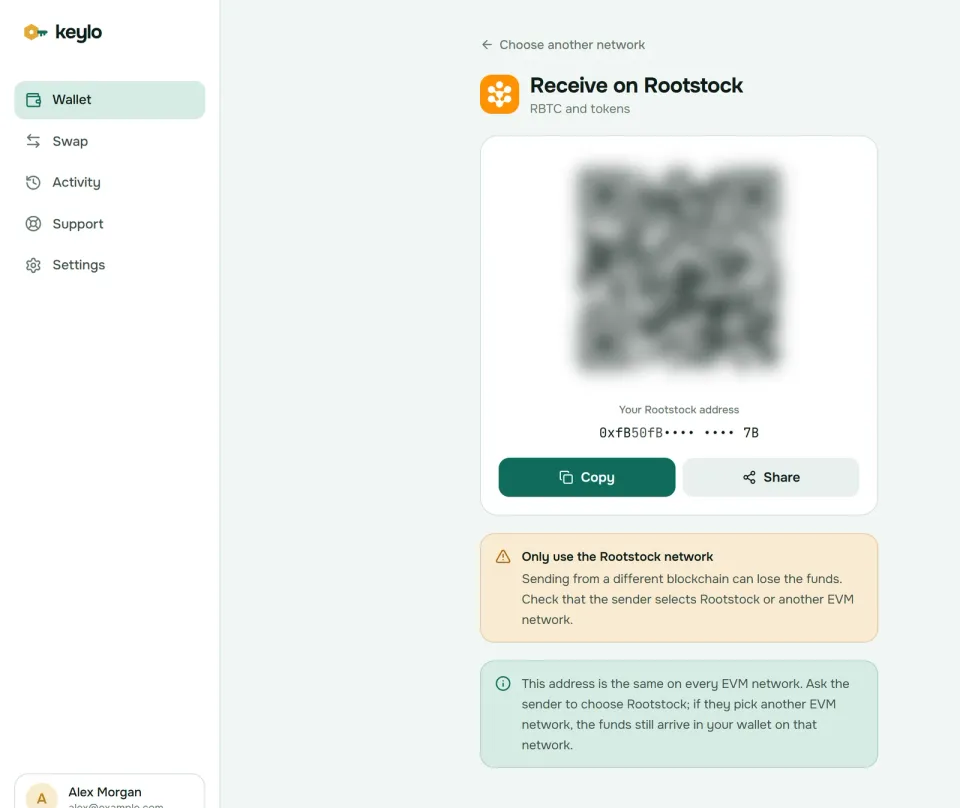
Tap Receive and choose Rootstock. The screen reads "Receive on Rootstock" and shows the QR code and "Your Rootstock address".
Tap Copy or Share. If the sender's wallet rejects it over capital letters, send them the lowercase version.
On an exchange, look for RBTC on the Rootstock network, sometimes labeled RSK, its old name. Never withdraw BTC on the Bitcoin network to this
0xaddress.Wait for the deposit in your activity list. A block arrives about every 30 seconds.
Fewer exchanges support RBTC than BTC, so check yours before you start. If it doesn't, then the PowPeg or Flyover below is the way in.
Rootstock's finality grows with each block, as on Bitcoin. So a payment in a block is safe for everyday amounts after a few confirmations. Exchanges and bridges usually wait longer for large sums, so a deposit can show on the explorer before an exchange credits it.
How to send RBTC and Rootstock tokens#
Tap Send and pick RBTC or a Rootstock token.
Paste or scan the recipient in To. Keylo checks the address against both Ethereum and Rootstock checksums.
Enter the amount, or tap Max. For RBTC, Max holds back the fee.
Tap Review and choose Slow, Normal or Fast. Each shows its cost and a rough time.
Check the network, the full recipient and the fee in RBTC, then tap Send.
Watch "On its way" turn into "Sent", with a link to the explorer.
Keylo simulates the transfer first and stops it if the token contract would refuse, so you don't pay gas for a failure. It also warns when the recipient is a contract and blocks sends to a token's own contract.
RBTC has 18 decimal places on Rootstock while BTC has 8, so tiny RBTC amounts show more digits than you'd expect. With 30-second blocks, a send can sit pending for a minute or two. If it stays stuck, Speed up on the finished screen resends it with a higher gas price.
Rootstock gas fees explained#
Rootstock doesn't use Ethereum's base fee. Each transaction names one gas price in RBTC, and miners include those above a minimum they record in each block. Miners can move that minimum by up to 1% per block, and the fees go to the merge-miners. Rootstock's gas documentation describes the rules in full.
On October 24, 2026, the minimum was about 0.024 gwei and the typical price about 0.026 gwei. With RBTC at roughly $80,600, that made fees look like this:
Action | Gas | Cost (October 24, 2026) |
|---|---|---|
Send RBTC | 21,000 | About 0.00000055 RBTC, roughly 4 to 5 cents |
Send a token such as DOC | About 35,000 to 50,000 | About 0.0000009 to 0.0000013 RBTC, roughly 7 to 11 cents |
Peg in through the PowPeg | Bitcoin network fee | No service fee, only the Bitcoin and Rootstock transaction fees |
Swap or bridge in Keylo | Varies | Network fees plus route fees, all listed in the quote |
Keylo's Slow option bids the current network gas price, while Normal and Fast bid 10% and 30% above it. Normal usually confirms in the next block or two. Keylo adds no fee of its own to a normal send.
Getting RBTC from BTC: PowPeg, Flyover and swaps#
Neither the PowPeg nor Flyover runs inside Keylo, so use the official PowPeg app for both, and check the address in your browser before you connect.
Route | Peg-in time | Peg-out time | Limits | Fees |
|---|---|---|---|---|
PowPeg | 100 Bitcoin blocks, about 17 hours | 4,000 Rootstock blocks, about 34 hours | 0.005 BTC minimum in, 0.004 RBTC minimum out | Network fees only |
Flyover | About 20 minutes | About 15 minutes | Set by the liquidity provider, 0.1 BTC per transfer at launch | Provider fee plus network fees |
Flyover works because liquidity providers advance you the funds after two Bitcoin confirmations, then settle with the PowPeg themselves. The Flyover documentation lists the current settings.
Inside Keylo, swaps and bridges on Rootstock come from LI.FI, which compares Rootstock DEXs and bridges to other EVM networks.
Tap Swap and set You pay to RBTC or a Rootstock token.
Set You receive to a token on Rootstock or another network. You can paste a contract address.
Compare routes by amount, time and fees, then open one to see Minimum you receive and Delivered to.
Confirm and follow the tracker until the funds land.
A bridge route either delivers or returns your funds, sometimes as a different token that still lands in your wallet. Keylo shows any service fee of its own as a separate line. The swap and bridge page has the details.
Stablecoins and tokens on Rootstock#
Rootstock tokens follow ERC-20 and need RBTC for gas. Keylo reads Rootstock's explorer index, so the tokens your address holds show up on their own, and Activity lists incoming transfers as well as your sends. Rootstock has several kinds of dollar token, and they aren't interchangeable:
DOC (
0xe700691da7b9851f2f35f8b8182c69c53ccad9db) is Dollar on Chain, a stablecoin backed by RBTC collateral in its own protocol.USDRIF (
0x3a15461d8ae0f0fb5fa2629e9da7d66a794a6e37) is a dollar token from the RIF ecosystem, also backed by on-chain collateral.USDT0 (
0x779ded0c9e1022225f8e0630b35a9b54be713736) is Tether's USDT0, as listed in the USDT0 deployment docs.RIF (
0x2acc95758f8b5f583470ba265eb685a8f45fc9d5) is the RIF ecosystem token, not a stablecoin.
The addresses above are lowercase on purpose, so any wallet accepts them. Collateral-backed stablecoins keep their peg through their protocol's design, not a bank account, so read how one works before you park a large amount in it.
Keylo also shows NFTs held at your Rootstock address in a read-only view. It can't send or mint them.
What Keylo doesn't do on Rootstock#
No PowPeg or Flyover. Use the PowPeg app with a supported wallet for native pegs.
No dapp connections. Without a browser extension or WalletConnect, Keylo can't open Rootstock lending or DEX sites. Its own swap screen covers trades.
No staking. Keylo stakes only on Cosmos SDK chains, so it can't stake RIF or RBTC.
No NFT transfers, hardware wallets or card purchases.
No testnet. Keylo has no Rootstock testnet, so test with a small mainnet amount.
Keylo is non-custodial. If you lose both your password and your phrase, nobody can open the wallet, Keylo included. The networks page lists every chain Keylo supports.
Rootstock scams and mistakes to avoid#
Fake peg sites. Lookalike PowPeg and Flyover pages ask you to send BTC to their own address. Type the official address yourself.
Mixing up networks. BTC on Bitcoin, RBTC on Rootstock, and wrapped bitcoin on Ethereum are three different assets. Match the network on every withdrawal.
Lookalike stablecoins. Anyone can deploy a token called DOC or USDT0. Compare the contract with the list above.
Approval phishing. Drainer sites ask you to approve a token or sign a message. Keylo can't sign website requests at all.
Fake support. Keylo staff never ask for your phrase or password. Use Keylo support, and see how Keylo protects your wallet.
A short checklist before you move real money:
The phrase is on paper, and Keylo has confirmed it.
You hold a little RBTC for gas.
The withdrawal network says Rootstock or RSK, not Bitcoin.
If a wallet rejected the address, you used lowercase and checked every character.
A small test arrived first.
Your Keylo phrase also covers the Bitcoin wallet and Ethereum wallet networks, each with its own guide.
Keep RBTC in a wallet only you control
Keylo encrypts your recovery phrase on your device and never sees it. Hold RBTC, BTC and stablecoins together.
Rootstock wallet FAQ#
Is RBTC the same as bitcoin?
RBTC is pegged one to one to BTC through Rootstock's PowPeg. BTC locked on the Bitcoin network backs RBTC on Rootstock, and a peg-out returns it. It's still a separate asset on a separate chain, with a 0x address and smart contracts. In Keylo, BTC and RBTC sit under different networks with different addresses, even though one recovery phrase controls both.
How do I convert BTC to RBTC?
The native route is a peg-in through the PowPeg app: you send at least 0.005 BTC and receive RBTC after 100 Bitcoin blocks, about 17 hours. Flyover in the same app takes about 20 minutes for a provider fee. Some exchanges also sell RBTC directly. Keylo doesn't run pegs, but your Keylo Rootstock address can receive the RBTC.
Why does my wallet say my Rootstock address is invalid?
Usually it's the checksum. Rootstock capitalizes addresses with EIP-1191, which includes chain ID 30, while Ethereum wallets expect EIP-55. A wallet that only knows one style rejects the other. Keylo accepts both on Rootstock. Elsewhere, use the all-lowercase address, which every wallet accepts, and check each character because lowercase skips the typo check.
Why does my imported Rootstock wallet show a different address?
Rootstock-native wallets often derive accounts on m/44'/137'/0'/0/N, while Keylo and MetaMask use Ethereum's m/44'/60'/0'/0/0. The same phrase therefore produces two different addresses. Your funds are still at the original one. Send them from the old wallet to your Keylo address, and leave a little RBTC there first if you need to move tokens.
How much are Rootstock gas fees?
Small but not zero. On October 24, 2026, a plain RBTC transfer cost about 0.00000055 RBTC, roughly 4 to 5 cents, and a token transfer about twice that. Rootstock uses one gas price above a miner-set minimum rather than Ethereum's base fee, and the fees go to merge-miners. Keylo shows the exact cost before you sign.
Can I use MetaMask with Rootstock?
Yes. Add Rootstock with chain ID 30, and MetaMask can hold RBTC and connect to Rootstock apps. It uses Ethereum's derivation path and checksum, so its addresses match Keylo's but may not match a Rootstock-native wallet's. If you paste a Rootstock-style address into MetaMask and it complains, use the lowercase version instead.
How long does a Rootstock transaction take?
Rootstock makes a block about every 30 seconds, so a send from Keylo usually shows "Sent" within a minute. Like Bitcoin, finality builds with each block, and exchanges or bridges may wait for more confirmations before crediting large deposits. A PowPeg peg-out takes much longer, about 34 hours, because it waits for 4,000 Rootstock blocks.